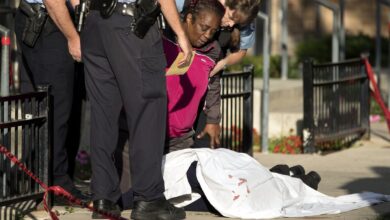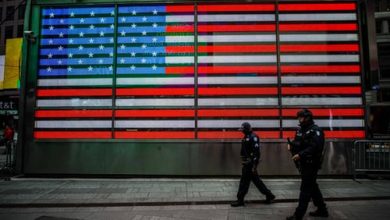

George Floyd’s homicide, the resulting mass fights, the recharged calls for police change and the preliminary of the previous cop sentenced for his homicide dominate an amazing reality: The speed of deadly experiences with police, who have killed around three individuals each day this year, is comparable to a year ago’s day by day normal.
Through the initial four months of the year, there have been only six days in which police across the United States didn’t kill anybody.
It’s a propping token of how little has changed notwithstanding a pandemic and extreme investigation of policing rehearses in the a year since the world saw the Floyd executing in Minneapolis.
“There’s an exertion, at any rate by some political entertainers, to give people bogus expectation that we’re turning the corner around police viciousness,” said Scott Roberts, ranking executive of criminal equity and majority rules system crusades at the racial equity bunch Color of Change. “These numbers show that, as should be obvious, it’ll proceed.”
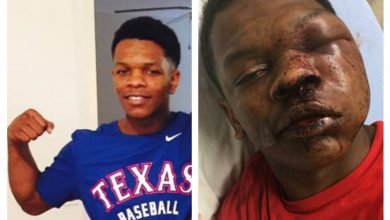
Individuals of color like youngster Ma’Khia Bryant, 20-year-old Daunte Wright and 42-year-old Andrew Brown Jr. have all endured a similar destiny as Floyd — thus numerous others before them — as of late: passing by police. They are among 89 Black individuals who have been murdered by police this year through May 21, as per Mapping Police Violence. Another teenager, Adam Toledo, who was Latino, was shot and executed by police in Chicago in March.
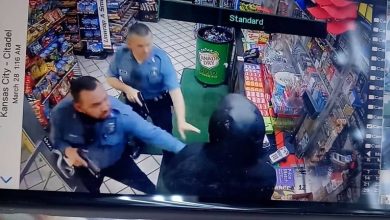
Caron Nazario’s life was saved, however the Afro Latino second lieutenant in the U.S. Armed force Medical Corps was pulled over by police in Virginia before the end of last year while in uniform. Weapons were drawn on him; he was pepper showered, compelled to the ground and cuffed following a traffic stop.
Film of the experience opened up to the world in April, around a similar time Wright, who was biracial, was killed at a traffic stop in Brooklyn Center, Minn., miles from where ex-Minneapolis cop Derek Chauvin went being investigated for Floyd’s homicide.
In a country wherein Black individuals are multiple times bound to be killed by police than white individuals — and 1.3 occasions bound to be unarmed when killed by police — the measurements are cursing.
“That strikes me as extremely difficult to think about a guiltless clarification or a fantastic clarification for that or a non-harmful clarification,” said Clark Neily, senior VP for criminal equity at the Cato Institute. “I can’t concoct a clarification that is something besides worried for that. It recommends, probably, a more elevated level of doubt and dread with respect to police and a more noteworthy readiness to fall back on deadly power without a second thought, and that is very unsettling.”
In interviews, activists had the option to feature a few indications of progress in their long fight as far as possible deadly experiences with police. They referenced Colorado and New Mexico, for instance, as the solitary two states to end qualified invulnerability, which safeguards police from claims by casualties or their families for supposed social equality infringement, and the CAHOOTS (Crisis Assistance Helping Out On The Streets) program in Eugene, Ore., where unarmed emotional wellness experts react to psychological well-being, vagrancy and habit emergencies.
In any case, activists are additionally clear-peered toward considerably more work should be finished. They point out the way that philanthropies and the media are doing the legwork on following lethal police experiences on the grounds that the national government neglects to gather and distribute such information.
“It’s a tremendous issue,” said Nancy La Vigne, leader overseer of the Council on Criminal Justice’s Task Force on Policing.
“There’s an exertion, at any rate by some political entertainers, to give people bogus expectation that we’re turning the corner around police savagery.”
Scott Roberts, ranking executive of criminal equity and popular government crusades at Color of Change
The not-for-profit think tank dispatched the autonomous team in November, and it delivered five needs for police change a week ago: public preparing norms, a government decertification vault, obligation to-mediate and obligatory announcing strategies, injury educated policing and expanded information assortment and straightforwardness.
“Information rises to responsibility,” La Vigne said. “Each organization should disclose their utilization of power episodes. Each and every office.”
The CCJ team’s needs call for public preparing guidelines, a government decertification library, obligation to-mediate and compulsory revealing approaches, injury educated policing and expanded information assortment and straightforwardness.
Maurice Mitchell, a tactician with the Movement for Black Lives and public head of the Working Families Party, portrayed the repetitive idea of police killings of unarmed ethnic minorities like this: public shock, a mass development then government reaction. The difficult he spread out is that administration authorities will in general zero in on manifestations and cycle, rather than main drivers and results.
A public library of police unfortunate behavior, finishing qualified invulnerability, building up commissions and even Justice Department assent orders are altogether responsive arrangement estimates that happen after hurt has effectively been done, he said.
“Every one of these things are not terrible, but rather what we hit the roads for were exceptionally clear results, and what we talked about were the main drivers,” Mitchell said. “We need to interfere with this cycle where Black people and supporters and others are requesting extremely, clear results, which is a straightforward result: We live in a general public where our administration doesn’t slaughter us. We trust it’s the real number and thickness of cooperations that individuals have with cops that lead to these cases.”
Law requirement authorities generally concur that the Chauvin decision — conviction on all charges — was the right one. In any case, making Floyd’s homicide about race is “totally off-base and flighty,” said Joe Imperatrice, originator of Blue Lives Matter NYC.
“That needs to stop since it’s messing more up,” he said.
Imperatrice was unyielding that “anyone” with “a large portion of a mind” could watch the video of Chauvin nailing his knee to Floyd’s neck for almost 10 minutes and see “that wasn’t right” and “obtuse.”
“Tragically,” he added, “policing isn’t in every case pretty.”
Activists demand the way of life and extent of policing are in urgent need of progress. The greater part of a year ago’s police killings started as traffic stops, psychological well-being or wellbeing checks, a homegrown unsettling influence or some other peaceful offense.
Reactions to supposed brutal wrongdoing prompted roughly 30% of a year ago’s 1,126 police killings. Casualties were supposedly furnished in almost 80% of every lethal episode, as per MPV information.
“While George Floyd’s name got kind of the mobilizing cry, it’s essential to perceive that there are at least 100 names of individuals who lost their lives since we have not completely resolved this issue,” said Sakira Cook, senior program chief for the equity change program at The Leadership Conference on Civil and Human Rights.
Criminal equity specialists regret that policing society is predicated on savagery, with mobilized police powers, overcriminalization of low-level offenses and a us-versus-them mindset inside police powers.
“Examination reveals to me they’re not selecting the opportune individuals for the work and they’re not preparing them for the work,” La Vigne said. “They’re preparing them to adopt a hero strategy as opposed to a watchman approach. They’re prepared in a battle ready style. They’re prepared on utilization of power, with a utilization of-power continuum that gets in their mind that you start with this measure of power and afterward you increment it to that sum and afterward a higher edge and a higher limit as opposed to being prepared in de-heightening, which is truly pre-acceleration.”
La Vigne depicted pre-acceleration as how police communicate with individuals: talk them down, utilize actual distance and perceive who’s in emergency. “That is the thing that’s required in harmony officials,” she said.
Americans need to reconsider the manner in which they see public wellbeing and wrongdoing, Cook said, and take a gander at policing along each mark of the continuum that lopsidedly influences networks of shading.
“Policing isn’t in confinement,” she said. “It’s associated with pre-preliminary framework. It’s associated with prosecutorial framework. It’s associated with condemning, what occurs in penitentiaries and what happens when individuals get back. These things are interrelated and interconnected.”
Examiners have additionally been a focal point of dissident gatherings like Color of Change as of late. The Cato Institute’s Neily recommended irreconcilable situations among examiners and cops could factor into why not many officials are criminally charged and indicted for murdering individuals.
“Policing isn’t in confinement … It’s associated with condemning, what occurs in detainment facilities and what happens when individuals get back.”
Sakira Cook, senior program chief for equity change at The Leadership Conference on Civil and Human Rights
The two men additionally addressed the number of rough experiences that don’t end in death and aren’t caught by cellphone video or body camera film go unreported. The Minneapolis Police Department at first guaranteed Floyd kicked the bucket following a “clinical episode.”
“Clearly, that is only a story. That is only one episode,” Neily said. “Yet, it was inappropriate to the point that one can’t resist the urge to consider how regularly are police divisions effective in hiding away from plain view conspicuous offense by one of their own officials?”