
It was on May 25, 2020, when a video started to get out and about via online media causing shock the nation over and the entire world.
In the video, at that point official Derek Chauvin had George Floyd lying face down on the asphalt, nailing him down with one knee to his neck.
In spite of Floyd’s steady supplications of “I can’t inhale,” just as supplications from bystanders and witnesses, calling for Chauvin and different specialists present to quit harming him, the official disregarded those solicitations, bringing about the demise of Floyd.
Once more, a Black man in America had passed on because of a cop and with that viral video, indeed, the Black Lives Matter development had taken off.
Arizona had encountered a comparative misfortune to Minnesota and had overall similar motivations to fight police severity. That very day, Dion Johnson was shot by an Arizona Department of Public Safety trooper after a traffic stop on Loop 101. The 28-year-old passed on in the wake of being taken to the medical clinic.
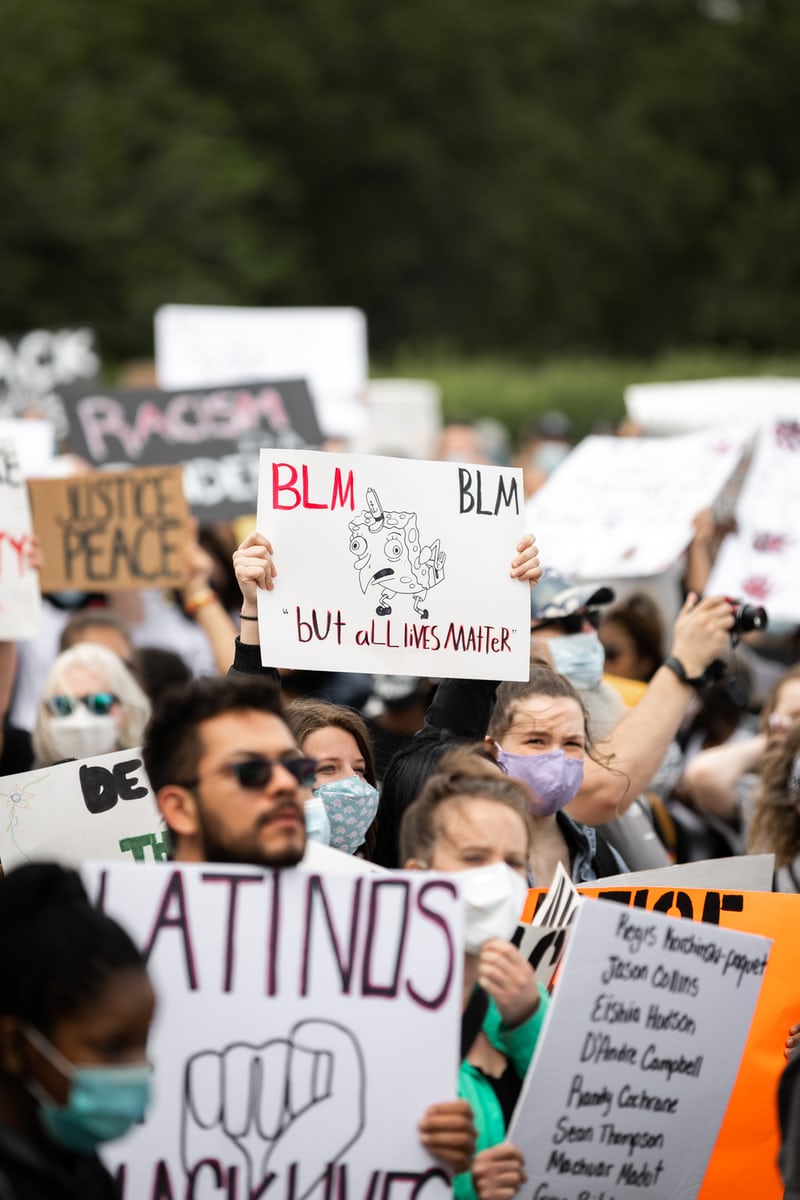
In Phoenix, associations like Poder in real life and Black Lives Matter Phoenix Metro mutually walked down city roads to call for equity and change — the fortitude among Latino and Black people group individuals apparently incredible.
Fundamental discussions arose about the kind of segregation that finished Floyd and Johnson’s life — a similar separation, as per Latino activists, that leads line specialists to keep migrants.
Via online media, exchanges were had with respect to the presence of Afro-Latinos and their consistent battle for their own perceivability and acknowledgment; banters about the significance of BLM and what this development means for the Latino people group, not simply Black Americans; and learning materials were dispersed so bilingual twenty to thirty year olds could introduce the issue of bigotry in the U.S. with their worker guardians and grandparents.
Similar as Black Americans, Latinos are likewise excessively influenced by police misuse.
A report distributed a year ago by the Arizona Republic, which takes a gander at the quantity of shootings including law authorization faculty in Arizona from 2011 to 2018, shows that cops shot 627 individuals in 600 unique experiences, of which 353 passings were recorded.
The Arizona Republic had the option to distinguish the race and identity of individuals associated with these shootings in 67% of the cases. Of these, 43% were white, 39% Latino, 13% Black, 4% Native American, and under 1% Asian.
Yet, in contrast to the Black people group, there is no comparative development cross country against such activities on Latinos.
One year after the occasions that prompted Floyd’s passing — occasions that keep on occurring in the U.S. until this point in time — and the then-apparent help of the Latino people group for the BLM development, where do local area individuals and activists stand today?
NOCAP Phoenix:Activist alliance looks for contribution in city-run emergency reaction program
Local area projects can save lives
Albeit on May 19 the Phoenix city board supported the making of a common straightforwardness office to direct the activities of law implementation, for certain activists that isn’t sufficient.
Cynthia García, from W.E. Rising Project, an association that promoters for correspondence and social equity, didn’t endorse the city of Phoenix expanding the police division spending plan — cash that, as she would like to think, might have been put resources into local area administrations.
“There is a ton of need locally, for example, the making of public venues, transportation administrations, local area help,” García said. “Financing these kinds of administrations would help the local area; it would save individuals from kicking the bucket on account of the police.”
She added that developments like Black Lives Matter, and the utilization of innovation, for example, mobile phones and online media, have opened the eyes of many, particularly Latinos.
She demonstrated that W.E. Rising is attempting to advance changes locally, where the goal is to strip from the police and utilize those assets to react to calls from individuals with psychological well-being issues, drug use and calls for prosperity.
Poder in real life is another association that ceaselessly battles against police savagery in Phoenix. Viri Hernandez, leader head of the association, talked with the Arizona Republic in August 2020 and determined that finishing police viciousness just as the coordinated effort between neighborhood police and migration officials were need issues to handle.
“Police are prepared to consider us to be as a danger. That isn’t reasonable in light of the fact that individuals who need them at this point don’t confide in them and will at this point don’t call them. They really accept that their own lives will be at serious risk in the event that they do as such, it is out of line,” García said.
So far in 2021, as per an examination by the Arizona Republic, cops have been associated with at any rate 28 shootings, in which at any rate 18 individuals have kicked the bucket.
Phoenix activists:Here are their 5 objectives for police change in 2021
More straightforwardness, less maltreatment
For Vice Mayor Carlos Garcia, a Phoenix city official who has consistently stood up against police fierceness, things have changed a piece since Floyd’s passing. Yet, more is required, he said.
He focused on that numerous who have passed on account of police officers in this city have been from the Latino people group, refering to the instance of Antonio Arce, the 14-year-old who was shot in the back by a previous Tempe cop when, frightened, he attempted to flee from the police with a non-deadly airsoft weapon in his grasp.
“We should join the discussion, in the things that are going on locally and in different spots, to consider it to be something that additionally impacts us and not just the Black people group,” Garcia said.
Garcia, who addresses District 8, driven a noteworthy decision on May 19 to endorse common oversight in the city of Phoenix.
With a vote of 5-4, Phoenix joined many urban areas the nation over in building up an Office of Accountability and Transparency, which will consider autonomous examinations concerning police lead, offering approach to more straightforwardness into how Phoenix police work.
For Phoenix Mayor Kate Gallego, the endorsement of this office is the first of numerous progressions that are coming in the region, changes that ought to have been made numerous years prior
“It is basic that we assemble a local area where all individuals have a sense of security. Our work doesn’t begin or end today. We realize that every individual who lives in the city of Phoenix is aware of what this gathering does. This exchange should not end. It needs to go further and contact more individuals. The change should proceed,” said Gallego after the committee vote.
‘Police-people group compromise is vital’
For Arizona Democratic Rep. Cesar Chavez, an institutional framework, for example, the police office can’t change for the time being. What is required, he said, is to have that police-local area compromise and complete perpetual, yet over every helpful discussion.
“Realize that the police are there to really focus on us and serve us; that we have a vast dominant part of police individuals who work effectively and should be regarded and advanced,” said Chavez.
“Yet, there is a little level of officials who make a picture for every other person. That little rate is the thing that we should observe so another circumstance like the one that occurred with George Floyd doesn’t occur once more, and ensure that those deliberate changes are made at this point.”
Chavez brought up that the essential solicitation is straightforwardness, and this will prompt an apparent change in the networks.
“I realize that numerous divisions have changed their arrangements, numerous states have additionally carried out changes, however I can reveal to you that in Arizona we are falling behind, and actually isn’t something that can do right by us, on the grounds that (in Arizona) we have likewise had circumstances.”
An examination led by The Ohio University covering a period from 2015 to 2020, found that Arizona positions fourth in lethal shootings by populace rate, just beneath Alaska, New Mexico and Oklahoma.
As indicated by that equivalent examination, Maricopa and Pima districts are situated in the Top 10 of the areas with the most lethal shootings by cops in the U.S.